Cheap Oscilloscope For Students Uk
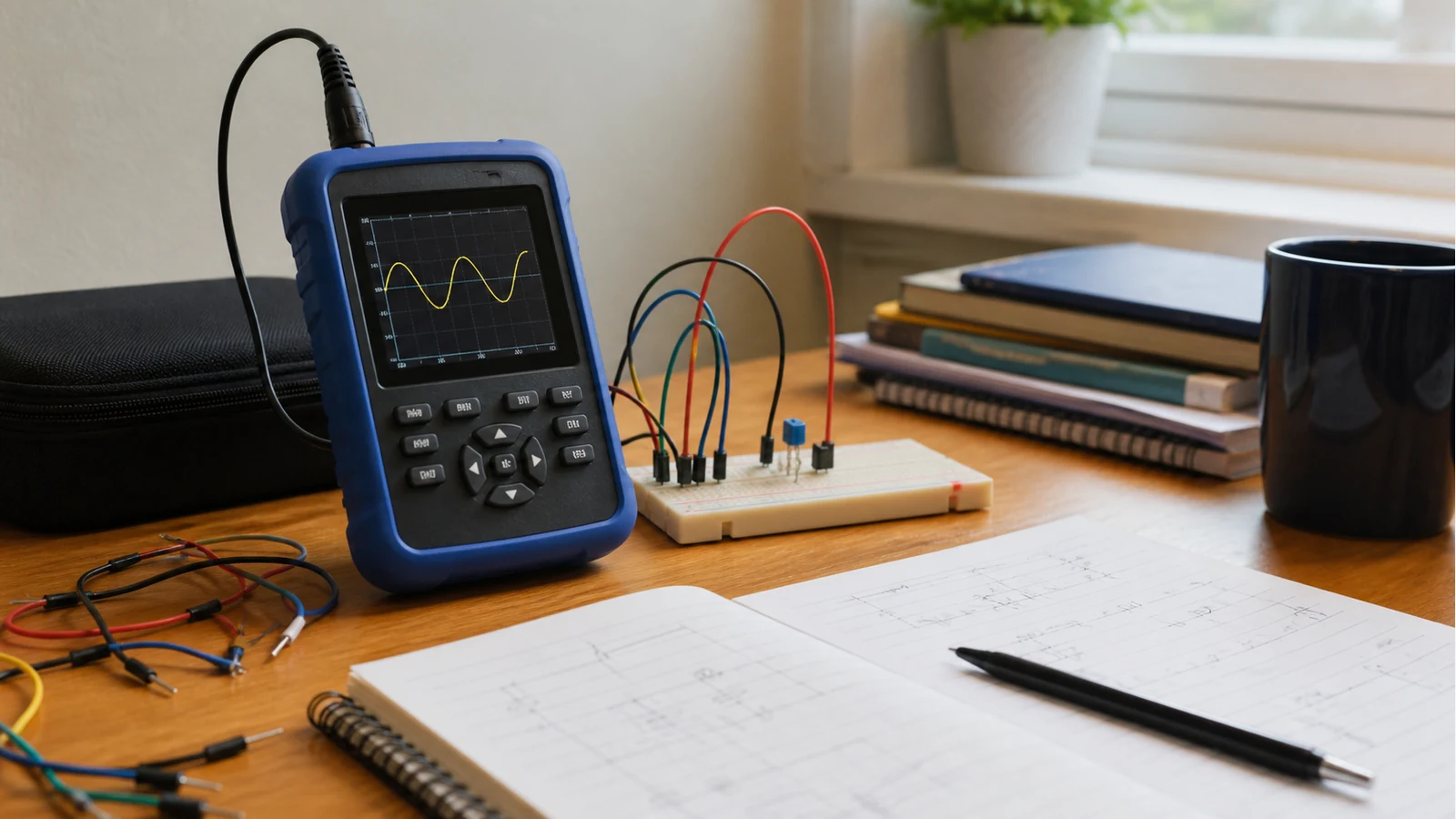
Direct answer: a cheap oscilloscope for UK students should teach real waveforms without becoming a toy purchase. Prioritise a clear display, simple trigger controls, AUTO setup for first captures, usable probes, realistic bandwidth for your course work and UK returns support over impressive but unused headline specifications.
What “cheap” should mean for learning
For a student, the scope has one job: make invisible signals visible often enough that theory becomes practical. A low-cost tool is useful if it encourages repeated practice. It is poor value if the screen is unreadable, the probe setup is confusing or the instrument is so limited that every lab exercise becomes a workaround.
UK education suppliers list 10MHz-class digital scopes for school and A-level style work, and compact hobby instruments are commonly sold for first labs and personal benches. That does not mean 10MHz is universally enough; it means you must match the tool to the tasks your course actually asks you to observe.
Student buying checklist
- Course fit: check whether you need simple waveforms, power-supply ripple, audio, microcontroller PWM or faster digital work.
- Display: you should be able to read the trace and divisions under normal desk lighting.
- Trigger basics: edge trigger and AUTO setup help beginners get a stable first trace.
- Probe included: confirm what probe or clip is supplied and learn attenuation before trusting readings.
- Portability: handheld makes sense if you move between home, college and shared benches.
- Support and returns: avoid treating changing live prices as the whole decision.
Pocket handheld, USB or entry benchtop?
A pocket or handheld scope is the easiest to carry and often the least intimidating. A USB scope can be better for saved screenshots and laptop-based reports. An entry benchtop unit is more comfortable for regular lab work but costs more space and money. Compare the formats in the USB versus handheld guide before focusing on one listing.
Who should wait or upgrade
Do not buy the cheapest handheld if your course already requires RF, high-speed digital timing, multiple simultaneous channels or formal lab documentation from PC software. In that case, borrowing a better lab instrument until you know your needs may be the wiser move.
A first capture plan
- Start with the scope's own calibration output or a simple signal source.
- Learn the probe switch and compensation basics using the X1/X10 probe explanation.
- Measure a low-frequency square wave, then a sine wave, then PWM.
- Write down what volts/div and time/div changed on screen.
Conditional next step
If you specifically want a portable first scope for personal practice, quick captures and learning outside a shared lab, Probeo's verified same-site route is here: handheld oscilloscope detail page. If your course requires a bench or PC workflow, use that requirement first.
Sources
- Better Equipped: UK education listing positions a 10MHz single-channel digital scope for KS4/GCSE/A-Level and electronics coursework.
- Kunkune UK: UK hobby retailer markets pocket scopes for school/college labs and first hobbyist learning.
- PCE Instruments: Entry compact 10MHz-class combo instrument marketed to hobby and education users.
- Hanmatek: Beginner guide emphasises auto-setup and entry digital storage scopes for learning curves.