Oscilloscope Bandwidth and Sample Rate for Automotive Work
Translate headline bandwidth and sample rate into the signal duration and detail that must be observed.
Short answer: Bandwidth describes the analogue frequency range passed with defined attenuation; sample rate describes how often the signal is digitised. Neither number alone proves that a scope can resolve a particular event. Start with the expected signal frequency, fastest edge, capture duration, memory and required channels.
This is a working guide for capability decision, not a rewritten product card. Begin with the current Probeo BSIDE 10 MHz handheld oscilloscope product page, then keep the exact manual, label or service information beside the task so a live specification is never mistaken for proof of the final result.
The decision this page helps you make
Translate headline bandwidth and sample rate into the signal duration and detail that must be observed. That means defining a pass condition before buying, fitting or using anything. If the necessary identity, safety limit or acceptance evidence is missing, the honest outcome is to pause rather than turn uncertainty into a confident claim.
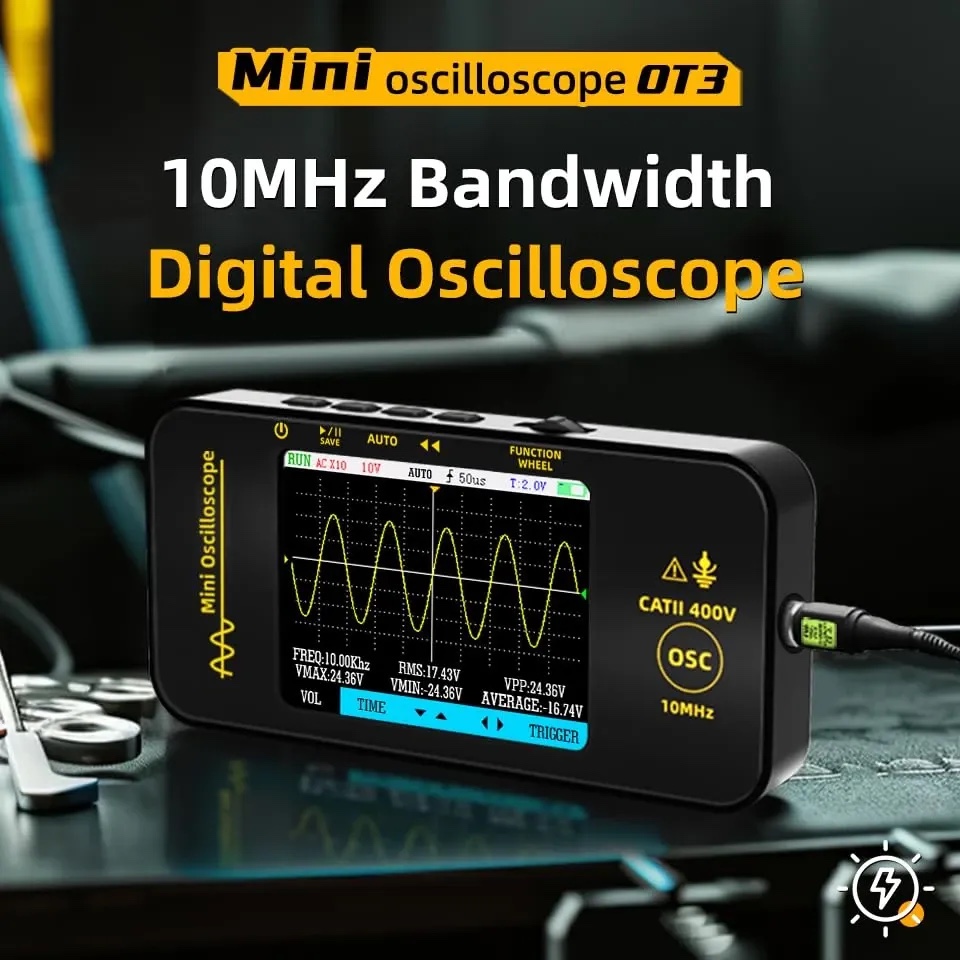
The product page currently says: The seller lists 10 MHz bandwidth, 48 MSa/s sampling, 1 Mohm input, a 3.2-inch 320x240 display and 1,500 mAh USB-C battery. The product is a BSIDE handheld described as an alternative to Hantek; that wording is not a claim of Hantek manufacture or equivalence. These are useful purchasing inputs, but they remain seller-provided specifications until the exact delivered item and current documentation agree.
The non-negotiable boundary is equally important: Oscilloscope inputs and grounds can create dangerous shorts or exceed the instrument rating. Verify the exact manual, probe attenuation, maximum input, reference-ground arrangement and circuit category before connection. Automotive suitability is application-specific, not proven by a broad product label.
A practical step-by-step workflow
- Step 1: Identify signal repetition rate and the fastest feature that matters.
- Step 2: Choose a time window long enough to include the fault event.
- Step 3: Check available sample rate at the channel count and timebase used.
- Step 4: Use probe attenuation that matches instrument settings.
- Step 5: Avoid interpreting an aliased waveform as vehicle behaviour.
- Step 6: Validate setup on a known signal where possible.
- Step 7: Save settings with every diagnostic capture.
Carry out the checks in order. For this specific decision, record the exact identity, the starting condition, the setting or method used and why the outcome was accepted or rejected. That turns a later change into something that can be diagnosed instead of an anecdote.
Evidence table
| Specification | Answers | Does not answer alone |
|---|---|---|
| 10 MHz bandwidth | Approximate analogue passband | Edge fidelity for every signal |
| 48 MSa/s maximum | Headline sampling ceiling | Rate available at every time span/channel mode |
| Display size | Viewing convenience | Capture memory or trigger capability |
| Battery operation | Portability/isolation context | Input safety or correct grounding |
Use the table as a stop/go record. When the current manual or service information gives a specific limit, that exact source takes priority over this general guide.
What the listing can and cannot prove
For Probeo BSIDE 10 MHz handheld oscilloscope, the listing can establish the current offer and the seller’s stated specification. It cannot independently establish the result described in this article. Ratings, discount badges and scarcity messages are not technical evidence. Where two statements conflict, preserve both, ask for written clarification and postpone irreversible work.
Common failure modes
- Applying a “five times frequency” slogan without considering edges.
- Ignoring memory depth and capture duration.
- Leaving probe set to 10x while scope assumes 1x.
- Mistaking aliasing for modulation.
- Quoting maximum sample rate without the active mode.
- Choosing by display screenshot alone.
A documented stop decision protects the item and the diagnostic trail. It also makes a supplier question or return easier because the mismatch was recorded before damage or modification.
How this page fits the wider topic cluster
Use the product page for the current offer. Continue to automotive diagnostic oscilloscope uk guide, handheld oscilloscope uk buying guide, oscilloscope vs multimeter automotive diagnostics only when that adjacent question becomes relevant. Together these pages cover buying, setup, evidence, maintenance and safety without repeating one broad buyer’s guide under several titles.
Frequently asked questions
What is the first check for this task?
Identify signal repetition rate and the fastest feature that matters. This first check matters because the rest of the workflow assumes the correct item, information and starting condition.
What result should be written down?
Record the result of “Save settings with every diagnostic capture.” together with the exact item or batch, relevant settings and any photograph or measurement that another person would need to repeat the decision.
Which product claim still needs verification?
The seller lists 10 MHz bandwidth, 48 MSa/s sampling, 1 Mohm input, a 3.2-inch 320x240 display and 1,500 mAh USB-C battery. The product is a BSIDE handheld described as an alternative to Hantek; that wording is not a claim of Hantek manufacture or equivalence. Treat each figure or compatibility statement as seller-provided until the delivered label and current documentation agree.
What is an immediate stop signal?
Applying a “five times frequency” slogan without considering edges. is one avoidable failure. Also stop whenever oscilloscope inputs and grounds can create dangerous shorts or exceed the instrument rating. Verify the exact manual, probe attenuation, maximum input, reference-ground arrangement and circuit category before connection. Automotive suitability is application-specific, not proven by a broad product label.
Sources and scope
The product specifications in this article are attributed to the live seller page. Decision and safety boundaries were checked against these primary or authoritative sources:
These sources define principles within their stated scope. They do not endorse Probeo BSIDE 10 MHz handheld oscilloscope, and no cited organisation is represented as having tested it.
Bottom line
Bandwidth describes the analogue frequency range passed with defined attenuation; sample rate describes how often the signal is digitised. Neither number alone proves that a scope can resolve a particular event. Start with the expected signal frequency, fastest edge, capture duration, memory and required channels. Read the exact instructions, decide what evidence would count as success, and keep a written stop rule. That is the difference between a useful topic-cluster article and a confident-looking product paraphrase.