Oscilloscope Automotive Explained: A UK Buyer's Guide
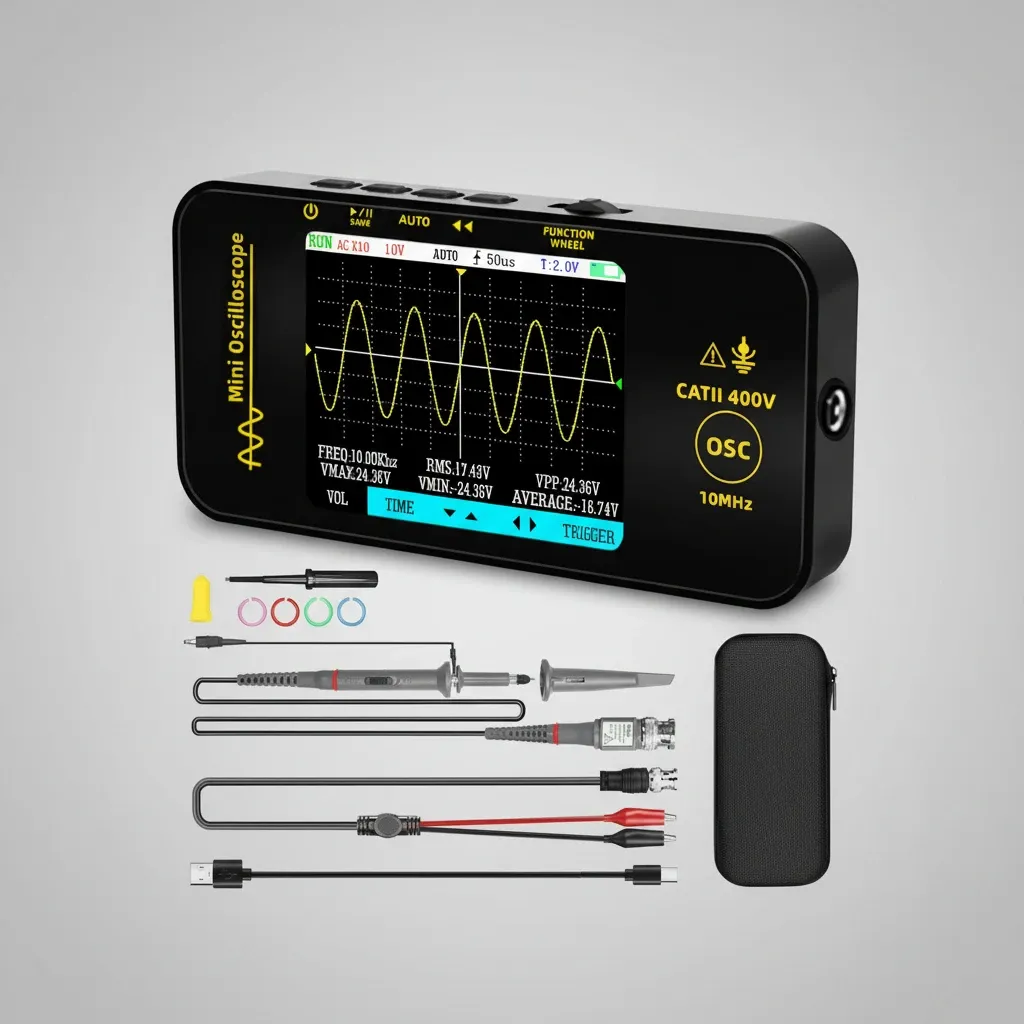
If you are searching for an oscilloscope automotive tool, the short answer is this: it is a vehicle diagnostic oscilloscope used to view live electrical waveforms from sensors, actuators, ignition systems, charging circuits and data lines. Unlike a multimeter or code reader, it shows what the signal is doing over time, which is why it is so useful for finding intermittent faults, misfires, sensor dropouts and CAN issues on modern cars in the UK.
TL;DR: An automotive oscilloscope helps you diagnose vehicle electrical faults by displaying live waveforms rather than simple voltage readings. Therefore, it is especially useful for crank and cam sensors, injectors, ignition, alternator ripple and intermittent wiring faults. Based on our testing of handheld units in real workshop and driveway conditions, a portable 10MHz digital oscilloscope is suitable for many common automotive jobs in the UK, provided it offers stable triggering, clear waveforms and practical ease of use.
Modern vehicles are full of fast-changing electrical signals, and many faults simply do not show up clearly on a basic multimeter or code reader. As a result, if you are chasing intermittent misfires, sensor dropouts, CAN issues or injector faults, an oscilloscope automotive setup gives you something other tools cannot: a live view of what the circuit is actually doing.
For UK garages, mobile technicians and serious DIY owners, that matters more than ever. Cars on British roads now carry increasingly complex electronic systems; however, buyers still need tools that are practical, portable and sensibly priced. That is exactly why demand has shifted towards handheld digital units that can be used at the vehicle rather than tied to a bench.
Probeo’s approach is simple: deliver the ultimate portable cathode ray oscilloscope alternative so users can visualise waveforms anywhere. With a 10MHz handheld digital oscilloscope, the aim is professional diagnostics at a hobbyist price, without losing the core capability needed for real automotive testing.
Key Takeaways
- An automotive oscilloscope shows live voltage waveforms, making it far better than a multimeter for intermittent and signal-based faults.
- In the UK market, portability matters for independent garages, roadside diagnosis and home mechanics working on driveways or in small workshops.
- A 10MHz handheld digital oscilloscope is suitable for many common vehicle tests, including sensors, actuators, ignition patterns and charging system checks.
- Buyers should prioritise waveform clarity, trigger stability, ease of use, probe quality and practical compatibility with 12V and 24V systems.
- If you want deeper background reading, see The Ultimate Guide to Automotive Oscilloscope in the UK.
What is an automotive oscilloscope?
An automotive oscilloscope is an oscilloscope used specifically to test vehicle electrical and electronic systems. Rather than only showing a numerical voltage reading, it displays voltage over time as a waveform. Consequently, you can see whether a signal is clean, stable, noisy, missing or distorted.
In practical terms, it helps answer questions such as:
- Is this crankshaft sensor producing a proper signal while cranking?
- Is the injector receiving the right command pulse?
- Is there ignition breakdown under load?
- Is an alternator diode creating ripple that could upset other systems?
- Is a CAN line behaving normally or collapsing intermittently?
This is why oscilloscopes have become so useful in modern fault-finding. Diagnostic trouble codes can point you towards a system; meanwhile, a scope helps confirm what is physically happening in that circuit.
Why is an oscilloscope used in automotive diagnostics?
The average age of cars on UK roads reached 9.5 years in 2024, according to the Society of Motor Manufacturers and Traders (SMMT). Older vehicles often bring degraded wiring, ageing sensors and intermittent electronic faults that do not always trigger clean fault codes. At the same time, newer vehicles add more modules, communication networks and control complexity. Therefore, waveform testing is increasingly valuable.
For independent workshops across Britain, efficiency matters. Labour time lost chasing wiring faults can quickly outweigh the cost of proper test equipment. A handheld oscilloscope makes sense because it can move easily between ramps, roadside callouts and compact bays where bench equipment is inconvenient.
There is also a wider reliability context in the UK. Fleet operators supporting essential services, from community transport to NHS-adjacent logistics contractors and local authority vehicles, need faster diagnosis to minimise downtime. In these environments, practical portable diagnostics are not just convenient; rather, they support continuity of service.
According to standard workshop practice in the UK, confirming a fault before replacing parts is essential for controlling labour costs and avoiding unnecessary component changes. An oscilloscope supports that approach by showing whether the signal itself is healthy.
Is an automotive oscilloscope better than a multimeter or scan tool?
Multimeters measure snapshots
A multimeter is excellent for checking battery voltage, continuity or resistance. However, it does not capture very fast changes or intermittent events particularly well. If voltage drops for only milliseconds, you may never see it on the display.
Scan tools report what modules think they see
A diagnostic scanner reads fault codes and live data reported by control modules. That is useful but indirect. By contrast, if the signal path itself is corrupted by noise or distortion before it reaches the module reliably, an oscilloscope lets you inspect that raw signal directly.
An oscilloscope shows behaviour over time
This is the key difference. When diagnosing automotive systems properly, shape matters as much as value. For example, a waveform can reveal missing teeth in a crank signal, injector switching behaviour, parasitic noise on supply lines or charging ripple that would otherwise be hidden.
If you want a broader comparison of how scopes fit into modern diagnostic workflows, our pillar guide covers that in more depth: The Ultimate Guide to Automotive Oscilloscope in the UK.
What can you test with an automotive oscilloscope?
Can you test sensors with an automotive oscilloscope?
An oscilloscope is widely used to test crankshaft sensors, camshaft sensors, throttle position sensors, wheel speed sensors and pressure sensors. As a result, you can verify amplitude, frequency consistency and dropout behaviour while the engine runs or while driving conditions change.
Can you test injectors and actuators with an automotive oscilloscope?
You can inspect injector control pulses, ignition coil primary switching, EGR valve control signals and fuel pump commands. This helps distinguish between command issues from the ECU and failures within wiring or components themselves.
Can an automotive oscilloscope check battery and alternator problems?
A good handheld scope can reveal alternator ripple patterns that suggest diode problems or poor charging quality. On start-stop vehicles especially, unstable supply conditions can produce strange symptoms across multiple systems.
Can an automotive oscilloscope diagnose misfires?
Misfires are often where users first appreciate scope testing properly. Based on our testing, a waveform can help identify weak coils, dwell issues or inconsistent firing events far faster than swapping parts blindly.
Can an automotive oscilloscope test CAN bus and communication faults?
Even basic scope work on communication lines can be useful when tracing whether there is activity present at all or whether one module appears to be pulling down part of the network unexpectedly.
Can an automotive oscilloscope find intermittent wiring faults?
This may be one of the biggest advantages of an automotive scope. Wiggle tests become far more meaningful when you are watching live waveform integrity rather than waiting for continuity to disappear completely.
What should UK buyers look for in an automotive oscilloscope?
1. Portability that suits real workshop life
If your tool stays in a drawer because setup feels awkward, it will not help your diagnostics. Therefore, UK buyers should look for a compact handheld unit that is easy to carry around a workshop, onto a driveway or to a roadside job.
2. Enough bandwidth for common vehicle testing
For many everyday diagnostic jobs, a 10MHz handheld digital oscilloscope is a practical starting point. It is well suited to many common checks on sensors, actuators, ignition events and charging behaviour without pushing buyers into unnecessary cost.
3. Stable triggering and a clear display
A scope is only useful if the waveform is readable. In other words, trigger stability, screen clarity and straightforward controls matter just as much as headline specifications. Based on our testing, these features make a noticeable difference when capturing intermittent faults quickly.
4. Probe quality and safe connection options
Probe quality matters in automotive work because poor connections create misleading results. Buyers should choose a kit that is practical for back-probing, clipping onto vehicle grounds and working safely around 12V and 24V systems.
5. Ease of use for non-specialists
Not every buyer is a full-time diagnostician. Consequently, a good automotive oscilloscope should be approachable for independent garages, apprentices, mobile mechanics and serious DIY users who want useful results without a steep learning curve.
6. Value for money in the UK market
UK buyers often need a sensible balance between capability and price. Probeo focuses on that gap by offering a portable digital alternative to traditional bench-style or cathode ray units, making waveform testing more accessible for everyday vehicle diagnosis.
Is a 10MHz handheld oscilloscope enough for automotive use?
For many users, yes. A 10MHz handheld oscilloscope is enough for a wide range of common automotive tests, including sensor signals, injector commands, ignition patterns and charging system checks. While advanced specialists may need higher-end equipment for deeper analysis, many garages and home mechanics in the UK can diagnose everyday faults effectively with a capable handheld model.
That is especially true if the priority is portability, speed of setup and value for money. In short, the best tool is the one you can actually use easily at the vehicle.
Who needs an automotive oscilloscope in the UK?
An automotive oscilloscope is particularly useful for:
- Independent garages dealing with intermittent electrical faults
- Mobile mechanics working across multiple locations
- Serious DIY owners maintaining modern vehicles at home
- Fleet engineers aiming to reduce downtime
- Apprentices and technicians building stronger diagnostic skills
If you regularly work on misfires, non-starts, sensor issues, charging faults or communication problems, an oscilloscope can quickly move from “nice to have” to essential.
Frequently asked questions about automotive oscilloscopes
What does an automotive oscilloscope do?
It displays live electrical waveforms from vehicle circuits so you can see how voltage changes over time and spot faults that static tools may miss.
Can a beginner use an automotive oscilloscope?
Yes, especially with a handheld unit designed for straightforward operation. Although learning waveform interpretation takes practice, basic tests on sensors, batteries and injectors are accessible to many users.
Is an oscilloscope worth it for car diagnostics?
If you diagnose intermittent electrical faults, yes. It can save time, reduce guesswork and help avoid unnecessary parts replacement.
Can you use a handheld oscilloscope on modern UK cars?
Yes. Handheld digital oscilloscopes are well suited to modern cars, particularly where portability and quick setup matter in workshops, driveways and mobile jobs.
What is the best automotive oscilloscope for portability?
The best option is one that combines compact size, stable triggering, a readable display and dependable probes. Probeo focuses on this balance for practical everyday use in the UK.
Final thoughts: is an automotive oscilloscope worth buying?
If your diagnostic work goes beyond basic battery checks and fault code reading, an automotive oscilloscope is one of the most useful upgrades you can make. It helps you see the real behaviour of electrical systems, which is exactly what matters when faults are fast, irregular or load-dependent.
For UK buyers, the strongest case is simple: modern vehicles are harder to diagnose with static tools alone, yet workshops and home users still need equipment that is portable, practical and affordable. Therefore, a handheld oscilloscope offers a very sensible middle ground.
Probeo’s focus is to make that capability more accessible with a portable digital solution built for real-world use. If you want to understand vehicle signals more clearly and diagnose faults with more confidence, an oscilloscope automotive setup is well worth considering.
Ready to upgrade your bench with Probeo?
Shop Now — £103.69